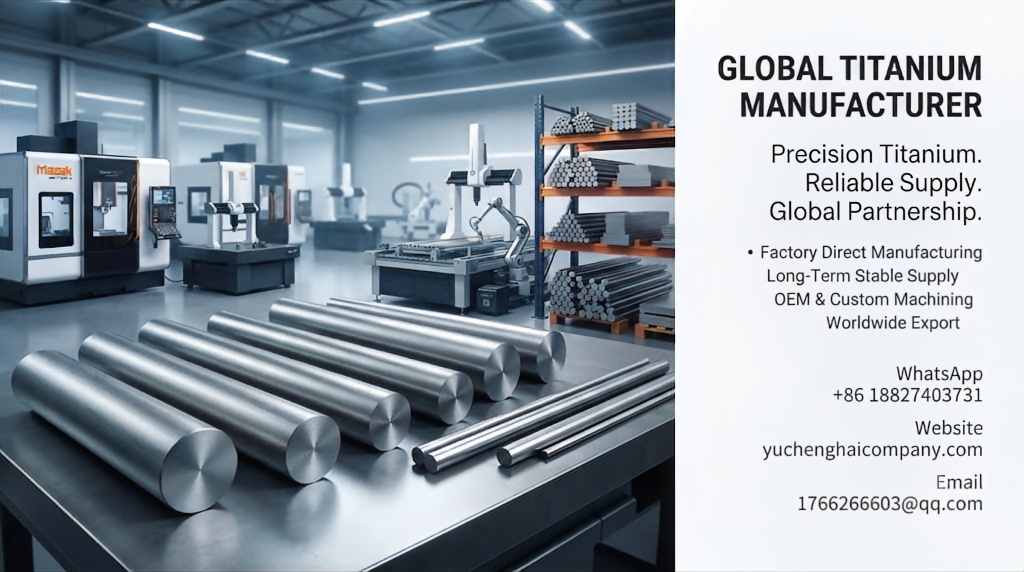
Selecting the wrong titanium bar supplier can halt projects, trigger batch rejections, or lower machining yields. This guide evaluates five core dimensions—manufacturing capability, quality systems, documentation traceability, supply flexibility, and export experience—to help you identify reliable partners during the inquiry stage.
Choosing a Supplier Is About Consistency, Not Just Price
In titanium bar procurement, margins for error are slim. Missing certificates or incorrect heat numbers can lead to rejection in aerospace, medical, and EPC projects. Some defects only surface during machining or service, costing far more than the material itself. Selection logic hinges not on "who is cheapest," but on "who delivers consistent quality, documentation, and reliability."
Dimension One: Manufacturing Capability
Manufacturing capability is the foundation for evaluating a titanium bar supplier. The key distinction lies not in equipment ownership alone, but in controlling the entire production chain—from melting and forging to heat treatment, testing, and final documentation.
Melting and Raw Material Control:Titanium alloys are typically double-melted using VAR (Vacuum Arc Remelting) to ensure chemical uniformity and inclusion control. Aerospace-grade materials may also undergo EBCHR or PAM processing to meet higher purity standards. More critical than owning a furnace is the ability to manage melting resources and maintain complete heat number traceability from ingot to finished product.
Forging and Rolling:The production process involves ingot → cogging/forging → rolling or forging to final size. Inquire about maximum ingot weight, diameter range, and forged bar capacity.
Heat Treatment:Verify controlled-atmosphere or vacuum furnaces and the ability to provide complete cycle records.
Testing and Laboratory:Evaluate in-house capabilities for chemical analysis, tensile testing, hardness testing, and ultrasonic testing (UT). Identify which tests are outsourced and verify the accreditation status of external laboratories.
Dimension Two: Quality Systems
ISO 9001 is the baseline. Industry-specific additions:
Aerospace:AS9100 is often required for direct OEM suppliers. For aerospace raw material suppliers, compliance with material specifications such as AMS standards and customer-specific requirements is typically more critical than certification alone.
Medical:Depending on the customer's supply chain requirements, ISO 13485 may apply. Titanium bar suppliers must provide ASTM F136-compliant or ISO 5832-3-compliant material, along with complete heat number traceability and documentation.
Oil & Gas:API Q1 may apply depending on the supplier's role; most operate with ISO 9001 and accept additional customer audits.
Go beyond certificates. Ask about recent audit results, non-conformance handling, and internal quality metrics.
Dimension Three: Documentation and Traceability
Even with conforming materials, non-conforming documentation can lead to rejection in critical industries.
Mill Test Certificate (MTC) / Material Test Certificate:Must clearly state the standard/revision, grade, heat number (the key identifier for heat traceability in international procurement), composition, mechanical properties, heat treatment details, and inspection date.
Heat Number Traceability:The heat number must be traceable through all production steps. Request a complete process description from ingot to finished product.
Multi-Standard Support:For export, verify cross-reference certificates (e.g., ASTM/GB/T) and language-specific versions (e.g., Russian).
EN 10204 3.2 Certificates:Requires validation by a buyer-appointed inspector; confirm supplier experience during inquiry.
NDT and Supplementary Documents:Verify in-house UT capability and availability of microstructure or contamination reports.
Dimension 4: Supply Flexibility
Procurement rarely involves large-volume, single-specification orders. Flexibility is essential for urgent maintenance, R&D trials, and mixed orders.
Minimum Order Quantity:Confirm acceptance of small-batch or single-piece orders.
Cut-to-Length and Machining:Support for custom lengths and surface finishes (turned, ground) is essential, especially for small-diameter precision titanium bars (φ3–20 mm) used in Swiss-type CNC machining and sliding-head lathe applications.
Inventory:Assess stock coverage for common grades and diameters to evaluate emergency response speed.
Dimension 5: Export and International Experience
For global buyers, export capability equals manufacturing capability.
Documentation:Proficient in commercial invoices, packing lists, certificates of origin, and Incoterms.
Packaging:Moisture, impact, and contamination protection; compliant with IPPC fumigation standards; sealed packaging for medical-grade use.
Communication:Proficiency in English or Russian and the ability to provide responsive technical feedback are essential.
Supplier Evaluation Checklist
Manufacturing:Melting resource control and traceability; forging/rolling capacity; heat treatment equipment; in-house testing.
Quality:ISO 9001 / AS9100 / ISO 13485; non-conformance handling; latest audit results.
Documentation:MTC sample review; heat number traceability process; multi-standard certificates (ASTM/GOST/EN/GB/T); NDT reports.
Flexibility:MOQ & trial orders; cut-to-length & surface services; small-diameter stock for Swiss-type and sliding-head lathe applications.
Export:Trade documentation; IPPC packaging; language & responsiveness.
Frequently Asked Questions
Q1: Trader or manufacturer?
Traders offer flexibility for standard industrial bars; manufacturers are preferred for aerospace, medical, and export projects requiring traceability.
Q2: Non-standard MTC sample?
It may reflect a weak documentation system rather than poor material, but it increases the risk of documentation errors during delivery.
Q3: How to verify production capability?
On-site audit is best. Alternatively, request equipment lists, capacity data, and historical supply records (with customer details redacted).
Q4: Material meets specifications but lacks certification?
Not recommended. Aerospace and medical standards require process control and documentation systems, not just composition. Validate with small batches and witnessed testing.
Conclusion
Your titanium bar supplier is the backbone of your project's material supply chain. Prioritize manufacturing robustness, documentation maturity, and export responsiveness over price alone.
Yucheng Hai Titanium, based in Baoji, China, specializes in small-diameter titanium bars for Swiss-type CNC machining and sliding-head lathes. We supply precision bars in TA1 (Gr.1), TA2 (Gr.2), TC4 (Gr.5), and TC4 ELI (Gr.23) for aerospace, medical, and industrial applications. Our offerings include tight straightness tolerances, precision surface finishes, and cut-to-length options. Each batch is fully traceable by heat number and comes with EN 10204 3.1/3.2 certificates, UT reports, and compliance with multiple standards including GB/T, ASTM, AMS, and GOST.
[Send us your specifications, standards, and documentation requirements for material selection advice, quotes, and delivery assessment.]
(Yucheng Hai Titanium | Precision Titanium Bar for Swiss-Type CNC Machining | TA1 / TA2 / TC4 / TC4 ELI |yuchenghaicompany.com)