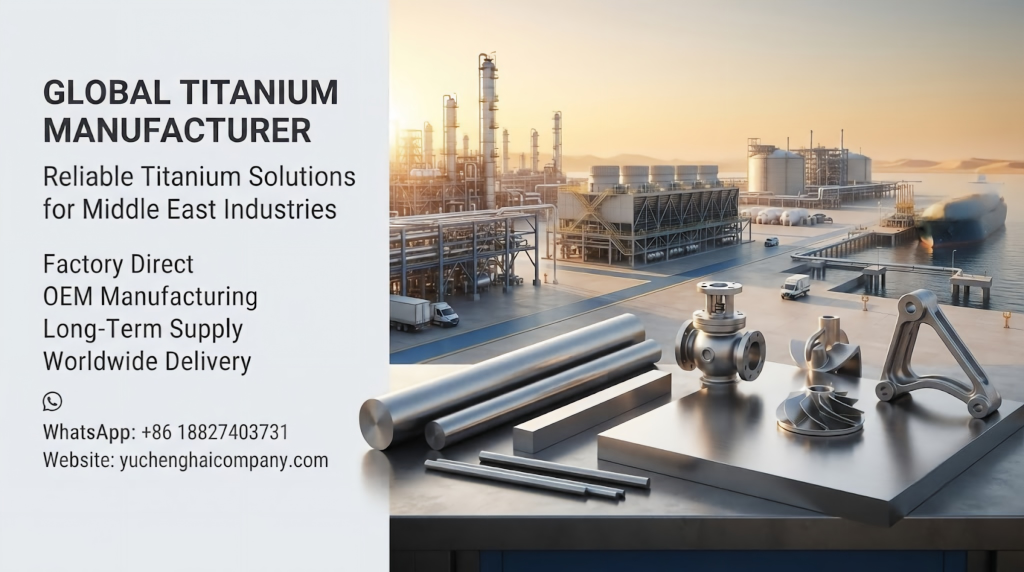
A practical guide to selecting titanium grades for sour service in the Middle East. Learn how Gr.2, Gr.5, Gr.7, Gr.12, and Gr.28 are evaluated under NACE MR0175/ISO 15156 for oil and gas applications.
Titanium Alloys in Sour Service: Material Selection Considerations under NACE MR0175 / ISO 15156
Meta Description:A practical guide to selecting titanium grades for sour service in the Middle East. Learn how Gr.2, Gr.5, Gr.7, Gr.12, and Gr.28 are evaluated under NACE MR0175/ISO 15156 for oil and gas applications.
In Sour Service, Using the Wrong Material Is a Ticking Time Bomb
Hydrogen sulfide (H₂S), commonly found in Middle Eastern oil and gas fields, poses a deadly threat to metals through sulfide stress cracking (SSC). In these projects, material selection is fundamentally a safety issue.
NACE MR0175/ISO 15156 is the internationally recognized standard for material selection in sour service environments. For many conventional metals, it mandates strict hardness limits and environmental constraints. Certain titanium alloys are listed in NACE MR0175/ISO 15156 for use under specified environmental and metallurgical conditions and are generally considered to have very low susceptibility to sulfide stress cracking (SSC). Across Saudi Arabia, the UAE, and Qatar, operators and EPC contractors are increasingly adopting titanium alloys for sour gas development, gas processing, and downhole tools—where permitted by project specifications and applicable environmental limits. The key drivers: high resistance to SSC under applicable conditions, excellent corrosion resistance, and relatively low maintenance costs over the full lifecycle.
Sour Service Material Comparison
Material Category | Typical Grades | Key Benefits | Limitations in Severe Sour Chloride Environments |
|---|---|---|---|
Austenitic Stainless Steel | 316L | Low-cost, mature fabrication | Pitting and SCC risks in high-temperature, high-chloride sour environments |
Duplex Stainless Steel | 2205, 2507 | High strength, excellent corrosion resistance | Application windows are strongly influenced by H₂S and temperature. |
Nickel-Based Alloys | Inconel 625, C-276 | Excellent corrosion resistance | Very high cost; heavier |
Titanium Alloys | Gr.2, Gr.5, Gr.7, Gr.12, Gr.28 | Lightweight, corrosion-resistant, and high SSC resistance | Higher initial procurement cost |
Why Titanium Stands Out
1. Very Low Susceptibility to SSC:Titanium alloys demonstrate high resistance within the temperature ranges covered by NACE MR0175, enabling design engineers to leverage titanium's strength while minimizing the risk of sudden brittle failure.
2. Outstanding Corrosion Resistance:Titanium generally exhibits excellent resistance in many chloride-containing sour environments. Grade 7 and Grade 28 offer a higher safety margin, especially in reducing acidic chloride environments where traditional stainless steels may be prone to stress corrosion cracking.
3. High Specific Strength:Titanium's low density and high strength make it ideal for downhole tools and lightweight structural components. In deep and ultra-deep wells, reducing string weight significantly lowers surface equipment requirements.
Commonly Used Titanium Grades for Sour Service
Grade | Key Benefits | Typical Sour Service Applications |
|---|---|---|
Gr.2 | Excellent corrosion resistance and cost-effective | Heat exchangers, piping |
Gr.5 (Ti-6Al-4V) | High strength, mature processing | Fasteners, valve components, downhole tools |
Gr.7 (Ti-0.2Pd) | Superior crevice corrosion resistance, especially in reducing acidic chloride environments | Heat exchangers, tube sheets, highly corrosive environments |
Gr.12 (Ti-0.3Mo-0.8Ni) | Cost-effective corrosion resistance | Piping, vessels, moderately aggressive sour environments |
Gr.28 (Ti-3Al-2.5V-0.1Ru) | High strength + corrosion resistance | Specialized corrosive oil & gas applications; specify only when required by project specifications |
Higher-strength titanium alloys such as Gr.19 and Gr.29 may be specified for specialized applications based on project requirements. Material selection must always be verified by the project corrosion engineer in accordance with NACE MR0175/ISO 15156 and the actual operating environment.
NACE MR0175 Procurement Considerations
Metallurgical Condition and Heat Treatment:Suppliers must provide complete heat treatment records. Controlling welding procedures and conducting post-weld inspections are critical, as subsequent machining and welding can affect cracking resistance.
Environmental Condition Assessment:Buyers must provide complete operating parameters: H₂S partial pressure, CO₂ partial pressure, temperature, pH, chloride concentration, flow velocity, and whether elemental sulfur is present. For conditions outside the standard's typical range, a fitness-for-service assessment may be required.
Material Certificates and Traceability:Each batch requires chemical composition and mechanical test reports, heat treatment records, NACE MR0175 compliance statements, and full heat number traceability. PMI reports may be required. Middle Eastern EPC contractors often also require ISO 9001; some demand API Q1 or specific oil company pre-qualification.
Selecting a Titanium Supplier for Middle Eastern Projects
Documentation Familiarity:Complete, traceable material certificates and compliance statements are mandatory.
Complete Documentation Package:Authentic certificates with full heat number traceability, heat treatment records, and compliance statements are essential.
Third-Party Inspection:Suppliers must cooperate with agencies such as SGS, TÜV, Bureau Veritas, and Intertek for on-site inspections.
Delivery Reliability:Suppliers must offer inventory flexibility and have experience with Middle Eastern customs clearance and documentation.
Frequently Asked Questions
Q1: Which titanium alloys are covered by NACE MR0175?Gr.2, Gr.5, Gr.7, Gr.12, Gr.19, Gr.28, and Gr.29, subject to applicable condition restrictions.
Q2: Are titanium alloys immune to hydrogen embrittlement?No. They show very low susceptibility under typical NACE conditions, but hydrogen embrittlement may occur under extreme conditions.
Q3: What's the difference between Gr.7 and Gr.12?Gr.7 (with Pd) enhances resistance in reducing acidic environments. Gr.12 (Mo + Ni) improves crevice corrosion resistance at a lower cost. Gr.7 delivers superior performance tailored to the environment.
Q4: What documents prove NACE MR0175 compliance?Material test certificates with full heat number traceability, heat treatment records, NACE compliance statements, NDT reports, and PMI reports as required.
Q5: Can your materials be used for downhole tools?We supply Gr.5, Gr.28, and other grades potentially suitable for downhole applications requiring NACE compliance, along with material recommendations and compliance documentation.
Procurement Checklist
Before requesting a quote, confirm:
✓ H₂S partial pressure
✓ CO₂ partial pressure
✓ Chloride concentration
✓ pH
✓ Operating temperature
✓ Flow velocity
✓ Pressure
✓ Product form
✓ ASTM standard
✓ NACE MR0175/ISO 15156 edition
✓ Third-party inspection requirements
✓ Material test certificate requirements
Conclusion
With high resistance to sulfide stress cracking and excellent corrosion resistance, titanium alloys are increasingly chosen for oil and gas projects in the Middle East. Selecting the correct grade and managing a compliant supply chain are essential for safe project operations.
[Send us your operating parameters and technical specifications — we'll provide a technical review, material selection recommendations, and documentation support.]
(Yucheng Hai Titanium | Titanium Plate, Tube, Bar, Wire, Forgings |yuchenghaicompany.com)