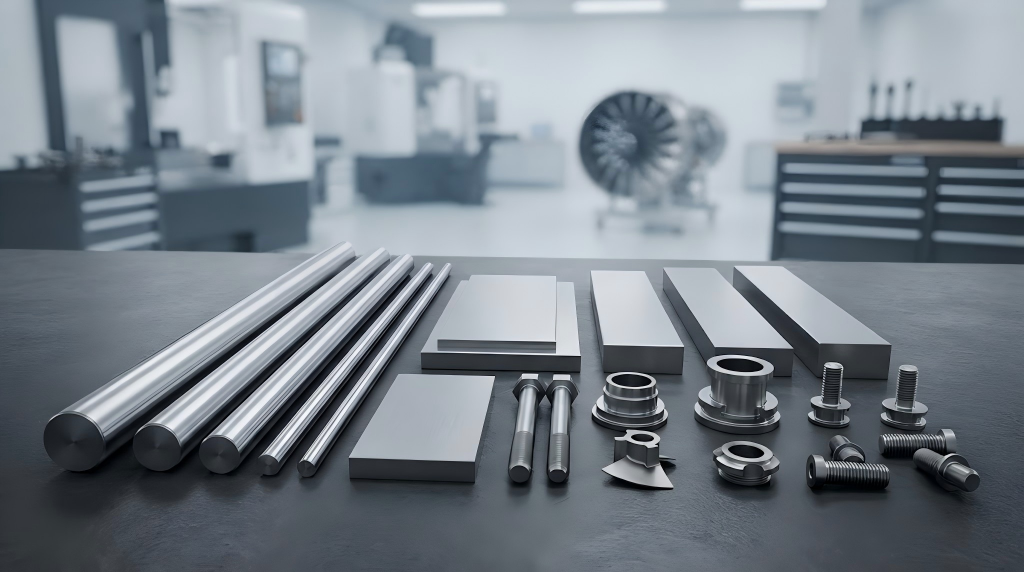
TA2, TC4, and TC4 ELI are the three most commonly specified titanium bar grades for industrial, aerospace, and medical applications. Selecting the wrong grade can lead to unnecessary costs, inadequate performance, or failure to meet industry certification requirements. This guide systematically explains chemical composition, mechanical properties, standards cross-referencing, and selection logic to help you quickly identify the right material for your service conditions. Mechanical property re
Three Tiers, Three Distinct Roles
TA2Commercially pure titanium is corrosion-resistant, weldable, and moderately priced. It is the most widely used grade in chemical processing, marine, and general industrial equipment.TC4(Ti-6Al-4V, Grade 5 offers excellent specific strength, making it the preferred choice for aerospace structures and oil & gas downhole tools.TC4 ELI(Grade 23) reduces oxygen, iron, and other interstitial elements, improving fracture toughness and fatigue crack growth resistance. It serves as the core material for orthopedic implants and fracture-critical components.
Standards Cross-Reference
Material Type | GB/T Grade | ASTM Grade | Product Standards |
|---|---|---|---|
CP Titanium (medium strength) | TA2 ≈ | Gr.2 | ASTM B348 |
Ti-6Al-4V Alloy | TC4 | Gr.5 | ASTM B348 |
Ti-6Al-4V ELI Alloy | TC4 ELI (industry designation) | Gr.23 | ASTM B348 (Industrial) / ASTM F136 (Implant) |
Important:"Correspondence" does not mean "equivalence." GB/T and ASTM standards differ slightly in composition ranges and mechanical properties. Final acceptance must comply with the standard specified in the contract.
TC4 ELI per GB/T:"TC4 ELI" is not a formal GB/T designation but an industry term for low-interstitial titanium. ELI characteristics are typically specified through supplementary technical agreements or customer technical specifications.
ASTM F136 vs. Grade 23:ASTM F136 specifies wrought Ti-6Al-4V ELI alloy for surgical implant applications, while Grade 23 is the alloy designation used across different product standards. Industrial ELI bar uses ASTM B348 Grade 23; medical implant bar uses ASTM F136.
Chemical Composition Comparison
Values shown represent typical limits based on widely referenced standards and may vary slightly depending on the applicable specification.
Element | TA2 (approx. Gr.2) | TC4 (typical Ti-6Al-4V) | TC4 ELI (Gr. 23; ref. ASTM F136) |
|---|---|---|---|
Aluminum (Al) | — | 5.50 - 6.75 | 5.50 - 6.50 |
Vanadium (V) | — | 3.50 - 4.50 | 3.50 - 4.50 |
Iron (Fe) | ≤ 0.30 | ≤ 0.40 | ≤ 0.25 |
Oxygen (O) | ≤ 0.25 | ≤ 0.20 | ≤ 0.13 |
Carbon (C) | ≤ 0.08 | ≤ 0.08 | ≤ 0.08 |
Nitrogen (N) | ≤ 0.05 | ≤ 0.05 | ≤ 0.05 |
Hydrogen (H) | ≤ 0.015 | ≤ 0.015 | ≤ 0.012 |
TA2:No aluminum or vanadium. Offers excellent corrosion resistance and weldability with the lowest strength level. Oxygen ≤0.25% combined with moderate iron content ensures an optimal balance of ductility and toughness.
TC4:Al-V alloying significantly improves strength. Offers excellent corrosion resistance in most environments, though welding demands stricter process control. Oxygen content capped at 0.20%.
TC4 ELI:Oxygen reduced to below 0.13%, iron tightened to ≤0.25. Strength is slightly lower, but fracture toughness and fatigue crack growth resistance are significantly improved. The added cost delivers meaningful safety margin gains.
Mechanical Properties Comparison
Typical minimum values per commonly referenced ASTM product standards; actual values may vary by standard and dimensions.
Property | TA2 (Gr. 2) | TC4 (Gr. 5) | TC4 ELI (Gr.23) |
|---|---|---|---|
Tensile Strength (MPa) ≥ | 400 | 895 | 860 |
Yield Strength (MPa) ≥ | 275 | 828 | 795 |
Elongation (%) ≥ | 20 | 10 | 10 |
Reduction of Area (%) ≥ | 30 | 25 | 25 |
TC4 and TC4 ELI tensile strengths are more than double those of TA2, making them ideal for load-bearing structures, fasteners, and downhole tools. TA2 offers the highest elongation (≥20%) and superior cold-forming capability. TC4 ELI exhibits significantly higher fracture toughness and damage tolerance than TC4, providing enhanced safety when cracks or defects may be present.
Price Level Comparison
Material certification and documentation requirements often impact total procurement costs more than the alloy itself.
Grade | Relative Price | Primary Cost Drivers |
|---|---|---|
TA2 (Gr. 2) | Lower | Commercially pure; simpler manufacturing |
TC4 (Gr. 5) | Medium to High | Alloying elements (Al, V); more complex processing |
TC4 ELI (Gr.23) | Highest | Ultra-low interstitial control; additional certification and documentation, including medical-grade |
The ELI premium stems from stricter interstitial control and additional testing requirements. For fracture-critical and implant applications, this premium represents a necessary investment in safety and reliability.
Product Forms and Supply Dimensions
Grade | Common Supply Forms | Typical Commercial Range | Heat Treatment |
|---|---|---|---|
TA2 | Hot-rolled, cold-drawn | Diameter 6–200 mm | Annealed (M) |
TC4 | Hot-rolled, forged | Diameter 10–300 mm | Annealed (M) / STA |
TC4 ELI | Hot-rolled, forged | Diameter 10–300 mm | Annealed (M) |
TA2's excellent ductility enables cold drawing to smaller diameters, making it a versatile precision titanium bar for machining. TC4 has a long-term service temperature of approximately 300°C. Medical-grade TC4 ELI bars are commonly supplied in smaller diameters for orthopedic and dental components, though larger sizes are also available. Always specify diameter tolerance, straightness, surface finish, and cut-to-length requirements when submitting an inquiry.
Three Most Common Procurement Mistakes
Error 1: Only the grade was specified, not the standard.
Incorrect: "Need TC4 titanium bar." Correct: "TC4 bar per GB/T 2965, annealed, diameter 50 mm."
Mistake 2: Confusing material standards with product specifications.
Incorrect: "Grade 5 titanium bar." Correct: "ASTM B348 Grade 5 titanium bar, annealed." Grade 5 is an alloy designation; B348 is the bar product standard.
Mistake 3: Substituted TC4 for TC4 ELI.
Strictly prohibited for medical implants and aerospace fracture-critical components. These two materials have fundamentally different fracture toughness and fatigue properties.
Grade Selection Logic
Select TA2 (Gr.2) when:
Primary requirement: corrosion resistance (seawater, chemical media)
Good weldability required
Moderate strength requirements, cost-sensitive
Typical: heat exchanger supports, chemical fasteners, marine piping flanges
Select TC4 (Gr.5) when:
High specific strength required
Aerospace structures, oil & gas downhole tools, high-performance equipment
Typical: Aircraft structural components, fasteners, well strings, and tools
Select TC4 ELI (Gr.23) when:
Orthopedic implants, spinal devices, dental abutments (regulatory requirements apply)
Fracture toughness and damage tolerance are critical.
Cryogenic temperatures, high cyclic loading, and high-reliability scenarios
Typical: surgical implants, fracture-critical aerospace components
Russian Market Note:TA2 ≈ BT1-0 (VT1-0), TC4 ≈ BT6 (VT6) — approximate only. No universally accepted direct GOST equivalent exists for TC4 ELI; confirm per customer technical conditions.
Medical Implant Material Note
Medical implant materials must comply with ASTM F136 and meet medical device regulations, manufacturing quality system requirements, and device registration pathways. Material certificates alone do not qualify an implant for clinical use. Not all TC4 ELI is suitable for human implants — only material produced and certified specifically to medical implant standards is applicable. The device manufacturer bears ultimate responsibility for biocompatibility evaluation and clinical validation.
Inquiry Checklist
✓ Standard & Revision:GB/T 2965, ASTM B348, ASTM F136
✓ Grade:TA2 / TC4 / TC4 ELI (or Gr.2 / Gr.5 / Gr.23)
✓ Dimensions:Diameter and length or cut-to-length
✓ Quantity:Pieces or total weight
✓ Product Form:Hot-rolled / Cold-drawn / Forged
✓ Heat Treatment:Annealed (M) / STA
✓ Surface Condition:Ground / Turned / Black Skin
✓ Material Certificate:EN 10204 3.1 / 3.2 / GB/T
✓ Additional:NDT, third-party inspection, certifications, destination
Frequently Asked Questions
Q1: Are TC4 and TC4 ELI interchangeable?
No. TC4 ELI has lower strength but higher fracture toughness and damage tolerance. Procurement must comply with drawing and standard requirements.
Q2: Are TA2 and ASTM Grade 2 equivalent?
They are approximately equivalent grades, not fully interchangeable specifications. While their nominal compositions are similar, there are subtle differences in requirements. Clearly define acceptance criteria during procurement.
Q3: What is the formal GB/T designation for TC4 ELI?
No independent "TC4 ELI" standard exists in GB/T. ELI characteristics are defined via supplementary agreements or customer technical specifications. Refer to ASTM F136 or ISO 5832-3 for formal ELI standards.
(Yucheng Hai Titanium | TA2 / TC4 / TC4 ELI Titanium Bar |yuchenghaicompany.com)